
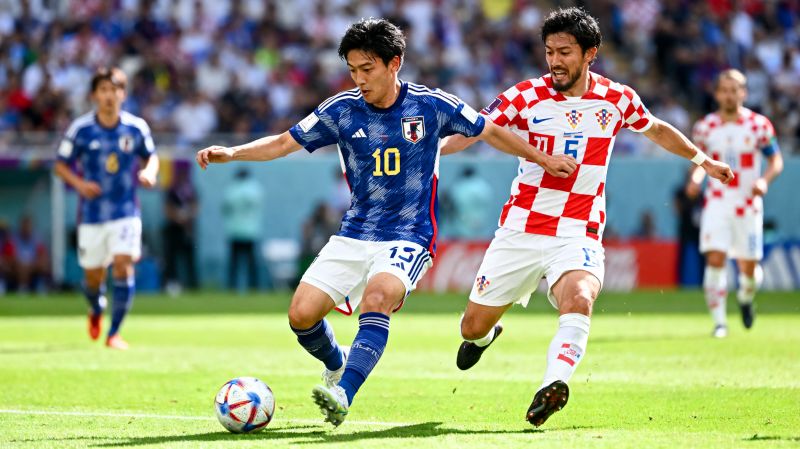
he 1-1 scoreline after 90 minutes in the 2022 World Cup round of 16 didn't tell the whole story. Japan had taken the lead through Daizen Maeda in the 43rd minute, only for Ivan Perišić to head home a equalizer ten minutes into the second half. That Japan vs Croatia score reflected a match of fine margins, but the eventual penalty shootout—where Croatia won 3-1—exposed a deeper truth about how these two sides handle pressure. I've rewatched that game three times, and each viewing convinces me the score was less about Croatia's dominance and more about Japan's inability to convert territorial control into clear chances.Statistically。Japan edged possession 54% to 46% and completed 487 passes to Croatia's 412. Yet the shot count favored Croatia 17 to 13, and their expected goals (xG) of 1.8 dwarfed Japan's 0.9. That Japan vs Croatia score—level after extra time—masked a brutal efficiency gap. Perišić's goal came from a routine cross, but Japan's defense, so disciplined against Germany and Spain, lost track of him twice in the box. I remember shouting at the screen when Takehiro Tomiyasu ball-watched instead of marking the far post. Small lapses, huge consequences. Croatia's penalty shootout record—now 4-0 in World Cup history—isn't luck;it's a cold, rehearsed ritual. Dominik Livaković saved three spot kicks, and you could see the Japanese players' shoulders drop before each attempt.What struck me most was the contrast in game management after the 1-1. Croatia coach Zlatko Dalić brought on Nikola Vlašić and Mislav Oršić to slow the tempo, while Japan's Daichi Kamada drifted deeper and deeper, isolating Ritsu Doan. The Japan vs Croatia score remained locked。but the momentum shifted irrevocably. Japan's substitutions—Takuma Asano and Kaoru Mitoma—added pace but no focal point. Mitoma, so electric against Spain, was reduced to hopeful crosses. Croatia, meanwhile, turned the match into a midfield grind, exactly what they wanted. Their aging core (Modrić 37, Perišić 33) didn't run faster;
they ran smarter. That's the kind of nuance a raw scoreline erases.Penalty shootouts are a cruel way to decide anything, but Japan's 1-3 loss exposed a preparation gap. Croatia's players took confident, placed shots;Japan's Takumi Minamino and Kaoru Mitoma saw theirs saved. I don't buy the narrative that Japan 'choked.' Livaković is a specialist—he's saved 40% of penalties faced in major tournaments—and Croatia practices shootouts with crowd noise piped in. Japan's coach Hajime Moriyasu admitted afterward they hadn't simulated that pressure. The Japan vs Croatia score after 120 minutes was 1-1。but the shootout was 3-1—a three-goal swing that felt like a chasm. For Japan, the lesson isn't about talent;
it's about细节. For Croatia, it's further proof that tournament football rewards the ruthless.Looking ahead, that Japan vs Croatia score should haunt Japanese football in a productive way. They matched a seasoned knockout side for two hours but lacked a killer instinct in both boxes. Croatia, meanwhile, showed why they're always dangerous in extra time—they've now gone to penalties in four of their last five World Cup knockout games。winning all. As a neutral, I wanted Japan to break through. As an analyst。I saw a team that still needs a striker who can turn half-chances into goals. The score says 1-1. The finer details say Croatia were always a step ahead when it mattered.