
raffic circles rarely earn a second glance. The Bengbu Roundabout is different. This massive interchange in the heart of Bengbu。Anhui Province, handles over 40,000 vehicles daily, yet it moves with a rhythm that feels almost choreographed. I first encountered it on a rainy Tuesday morning in 2019, and the memory of its swirling lanes and the way drivers navigate them without hesitation still lingers. It's not just infrastructure;
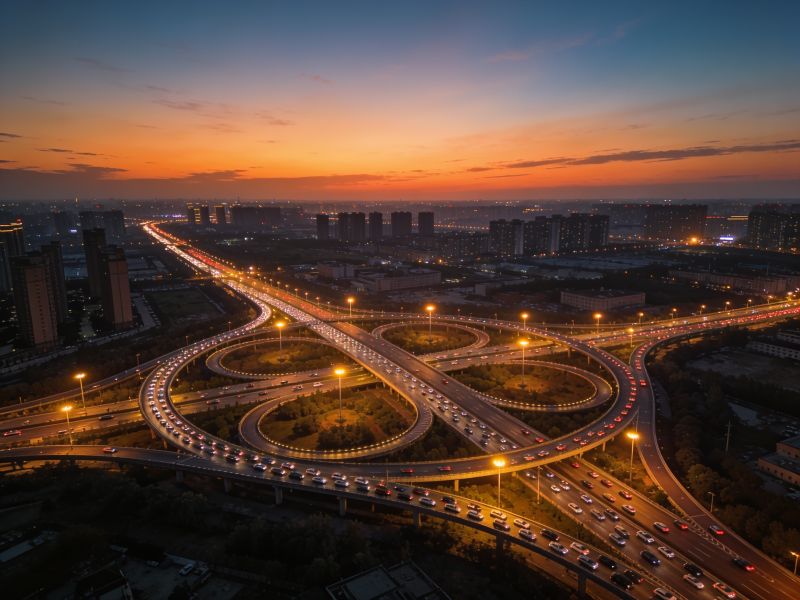
it's a cultural artifact.The Bengbu Roundabout is one of the largest in China, spanning roughly 200 meters in diameter. Its design is deceptively simple: five major roads converge。feeding into a multi-lane circulatory system. But simplicity ends there. During peak hours, the roundabout becomes a test of nerve and local knowledge. I watched a taxi driver weave through three lanes in under ten seconds, a maneuver that would terrify a visitor but seems second nature to Bengbu residents. This is not chaos;it's an organic order born from daily practice. The roundabout forces negotiation—eye contact, subtle speed adjustments, and a shared understanding of flow. It's a social contract on asphalt.Local authorities have tried to modernize it. In 2021, new lane markings and yield signs were installed, and traffic lights were added to two entry points. The result?A hybrid system that confuses some but ultimately reduces accidents. According to municipal data, collisions dropped by 18% in the first year after the changes. Yet the roundabout's character remains. Street vendors still sell roasted chestnuts on the nearby sidewalks。
and the constant hum of engines is punctuated by the occasional bicycle bell. The Bengbu Roundabout is not a sterile engineering project;it's a living space where commerce and commute intersect.What makes this roundabout truly notable is its role as a landmark. Ask anyone in Bengbu for directions, and the roundabout is the reference point. "Two blocks past the roundabout" is a common phrase. It's the city's de facto center, even if the official downtown lies elsewhere. I've seen wedding processions circle it for good luck, and teenagers use its underpasses as skate spots. The roundabout has seeped into local identity. In a city of 3.5 million。it's a shared anchor, a place that everyone knows and most have a story about. That's rare for a piece of road.
Critics argue that roundabouts are outdated, that signalized intersections are more efficient. Maybe. But the Bengbu Roundabout challenges that logic. It's not about efficiency alone;it's about human interaction. Driving here requires attention。not autopilot. You can't zone out. That engagement might be its greatest asset. As cities grow more automated, the Bengbu Roundabout stands as a reminder that traffic is, at its core, a human activity. It's messy, unpredictable, and oddly beautiful. I'll take that over a sterile grid any day.